
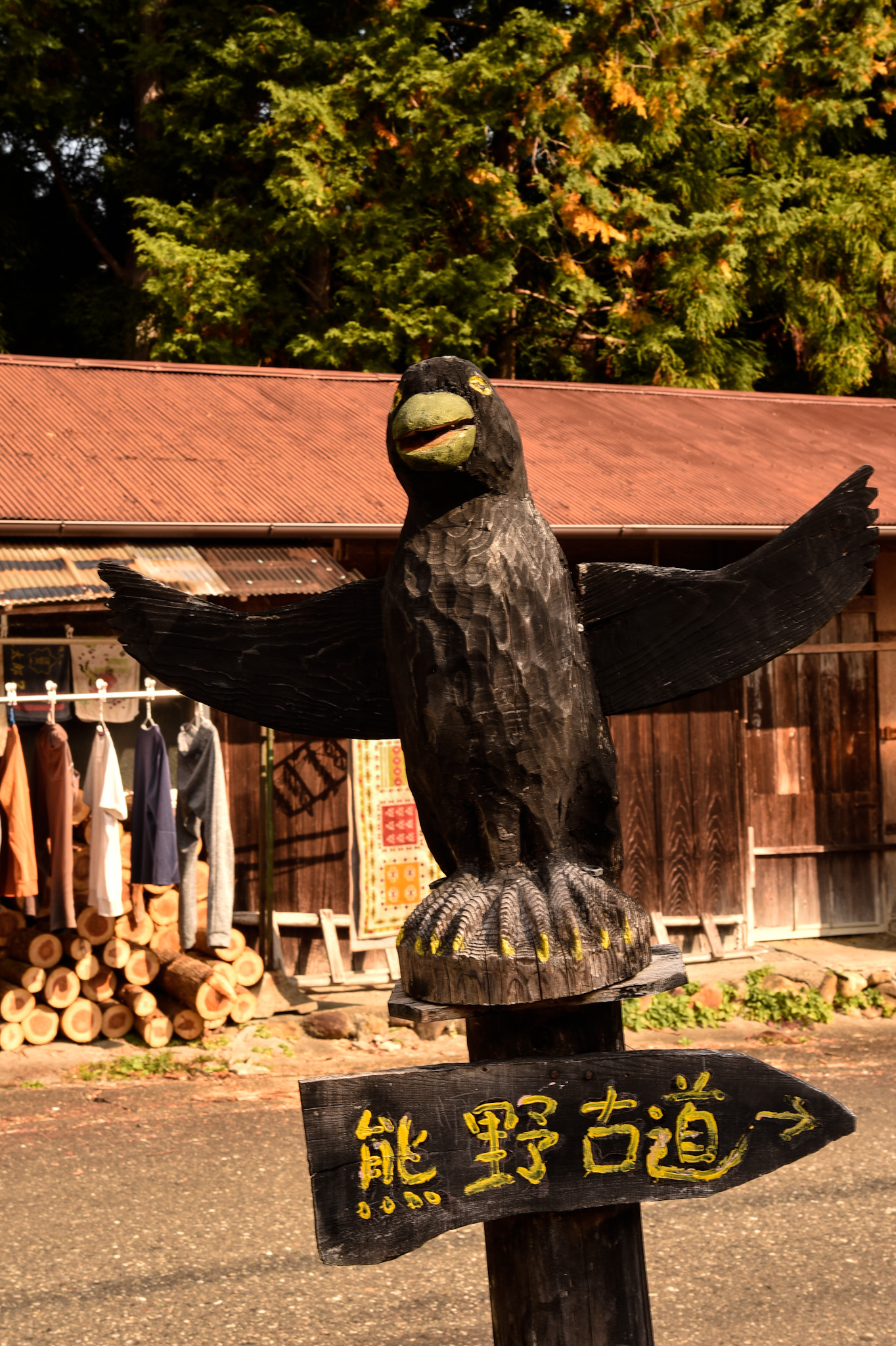
The three-legged raven (Yatagarasu) directed us to the next shrine.The Crow-God is symbolic of guidance, said to have been sent from heaven as a guide for Emperor Jimmu on his Kumano Koda journey. Yatagarasu is also the Japanese soccer team’s symbol.

We headed up the mountain range trail.
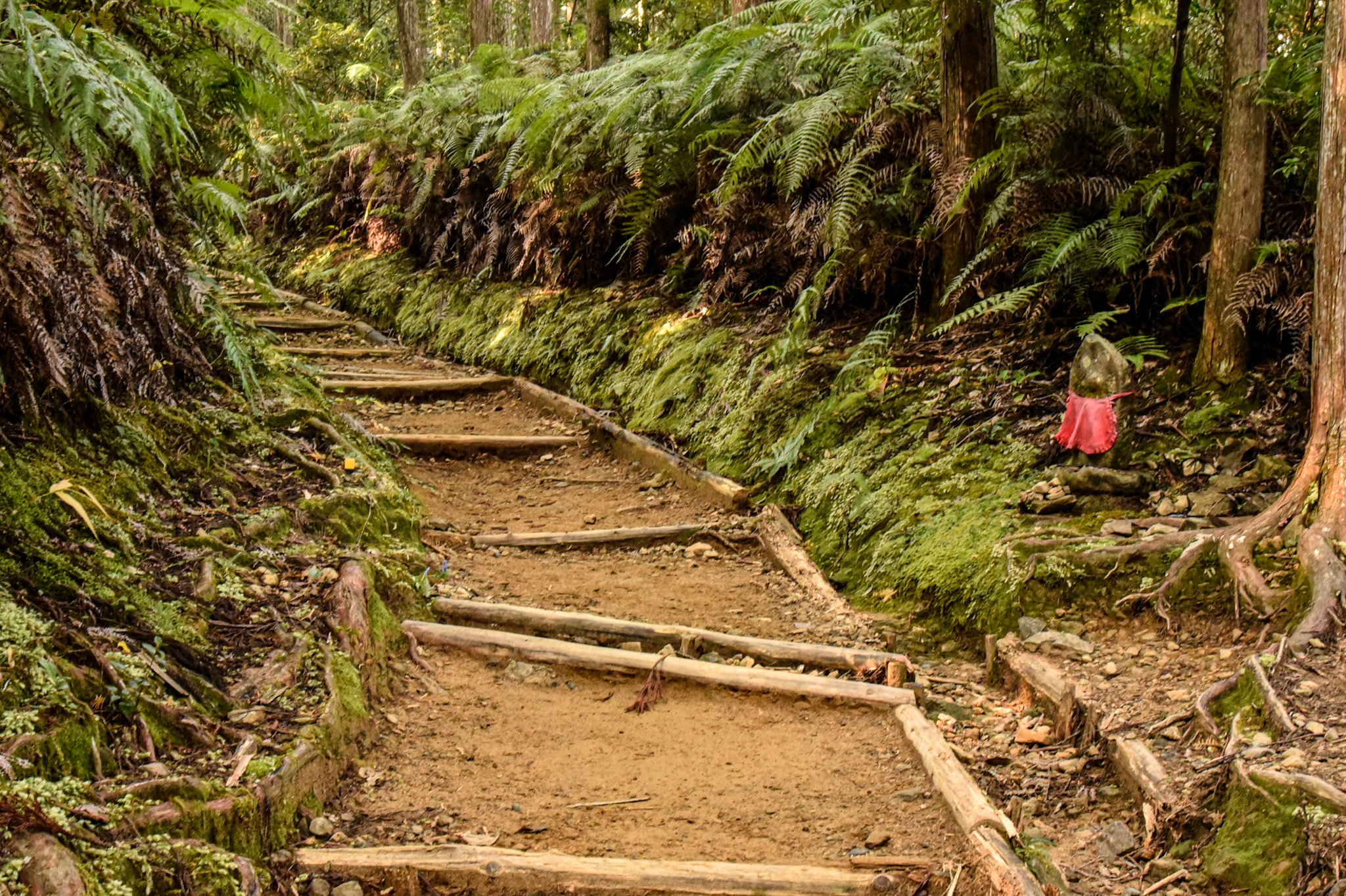
The climb was pleasant. Along the way we saw the little stone statues wearing the distinctive red bibs.
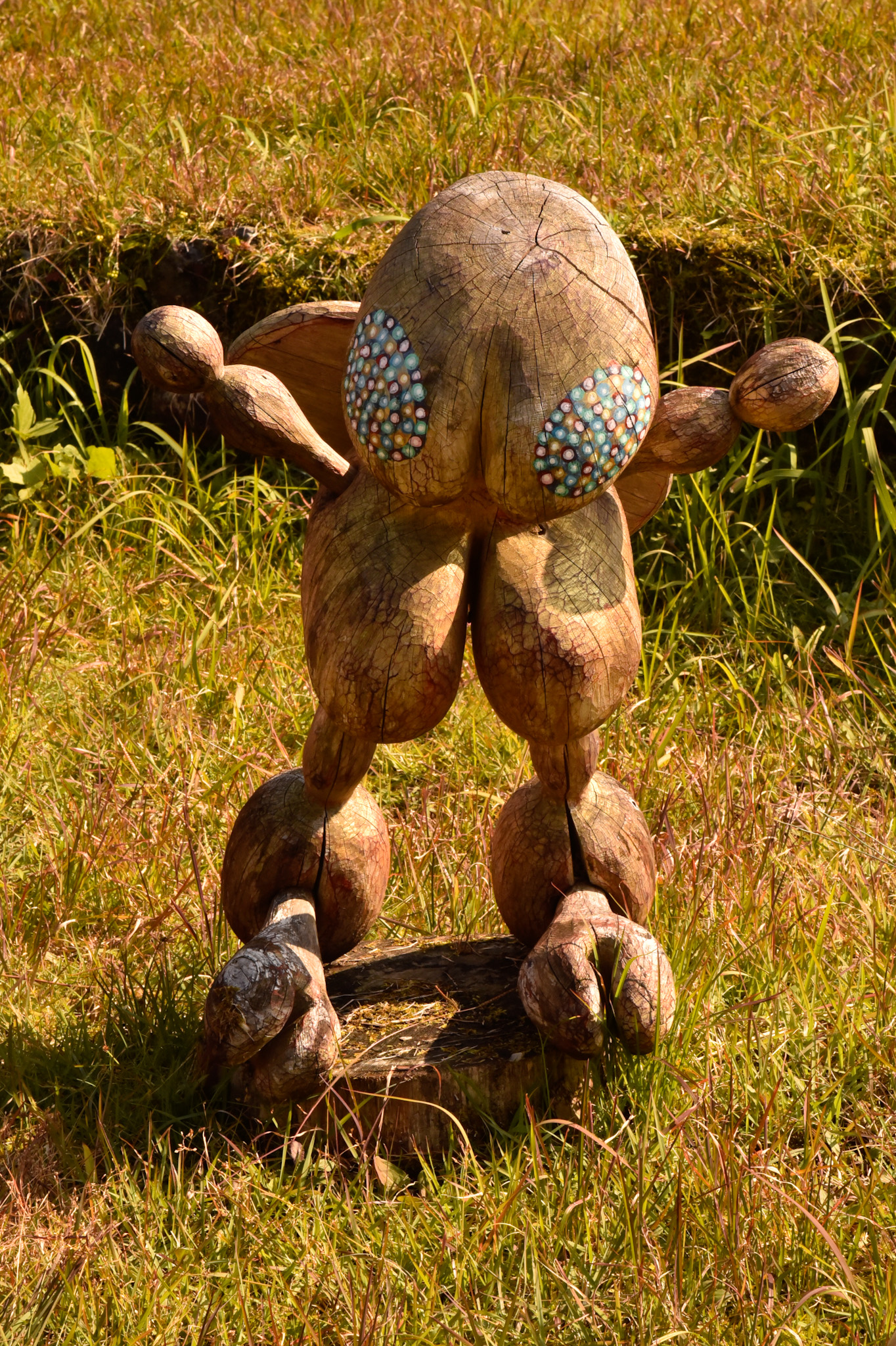
A farm had wood sculptures arranged on the lawn.
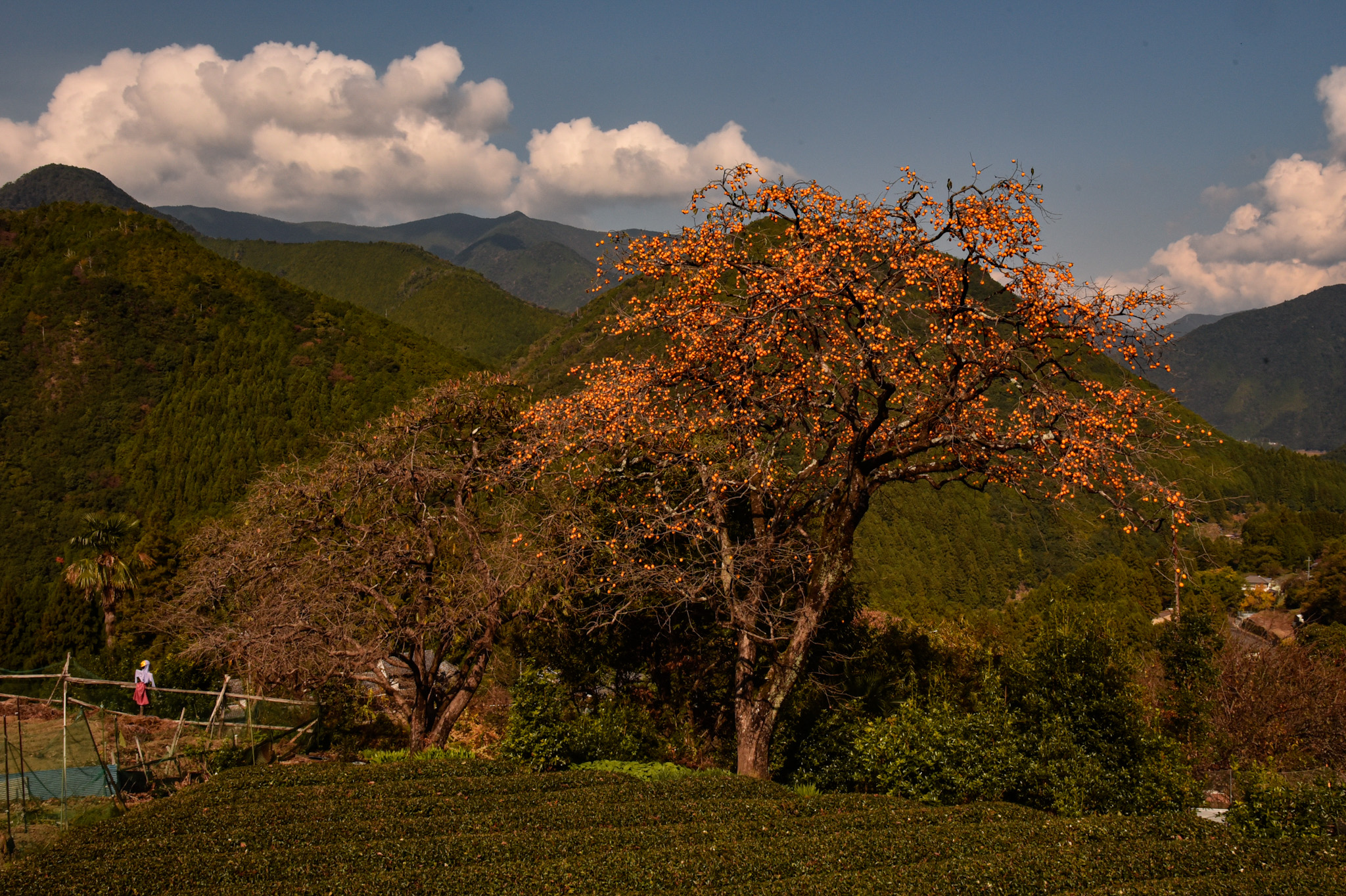
Fall is when Persimmons trees bear fruit. Japan is the 3rd largest Persimmon producer in the world harvesting 21 million tons annually.

We looked down at the largest TORII shrine gate in the world, marking the original site of the Kumano Hongu Taisha. In 1889 the original shrine was damaged by flood and relocated to higher ground.
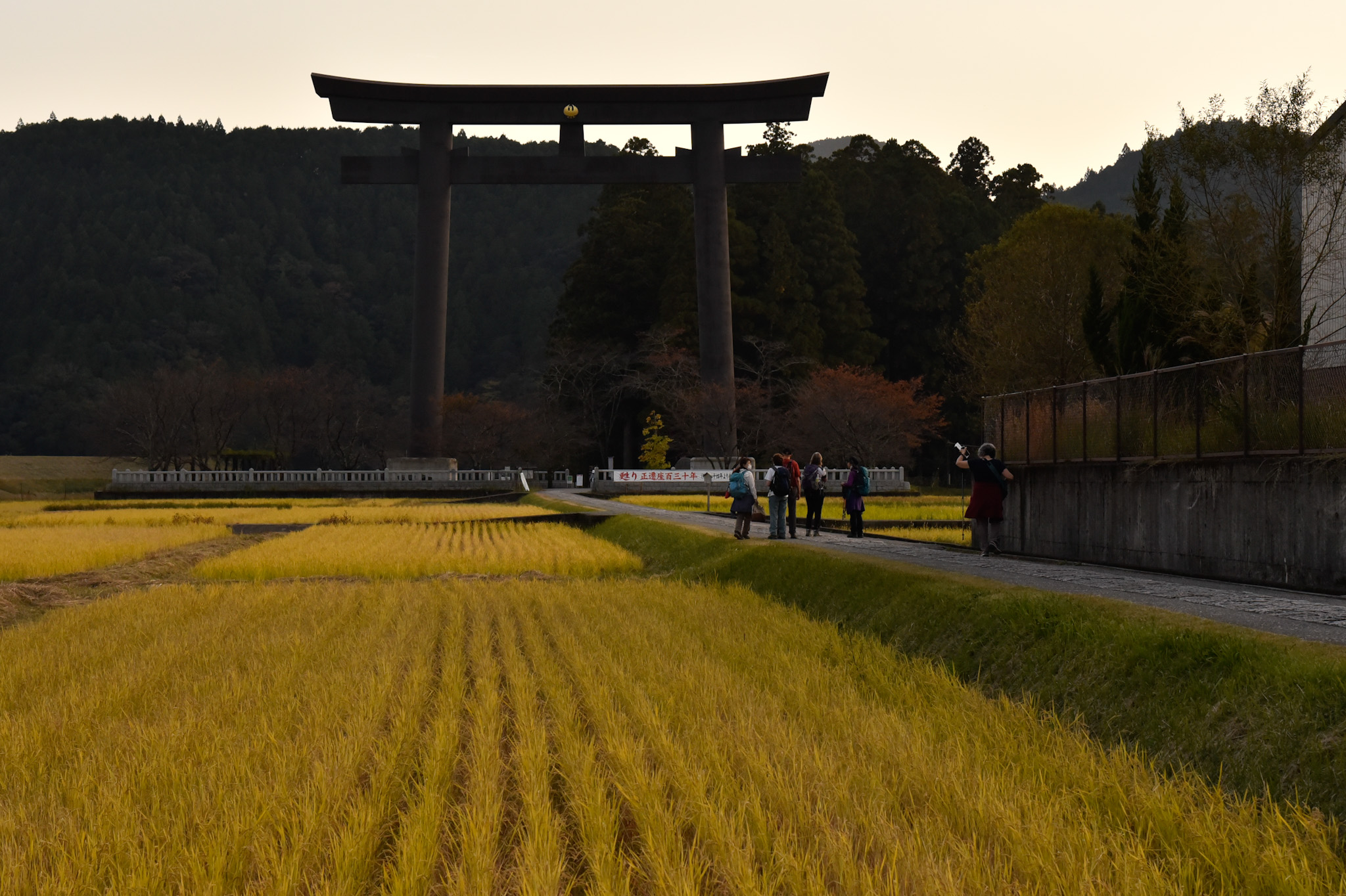
You pass through rice paddies to get to the TORII gate built in 2000, which it is said marks the separation between the secular and spiritual worlds. It is made of steel and weighs 172 tons.
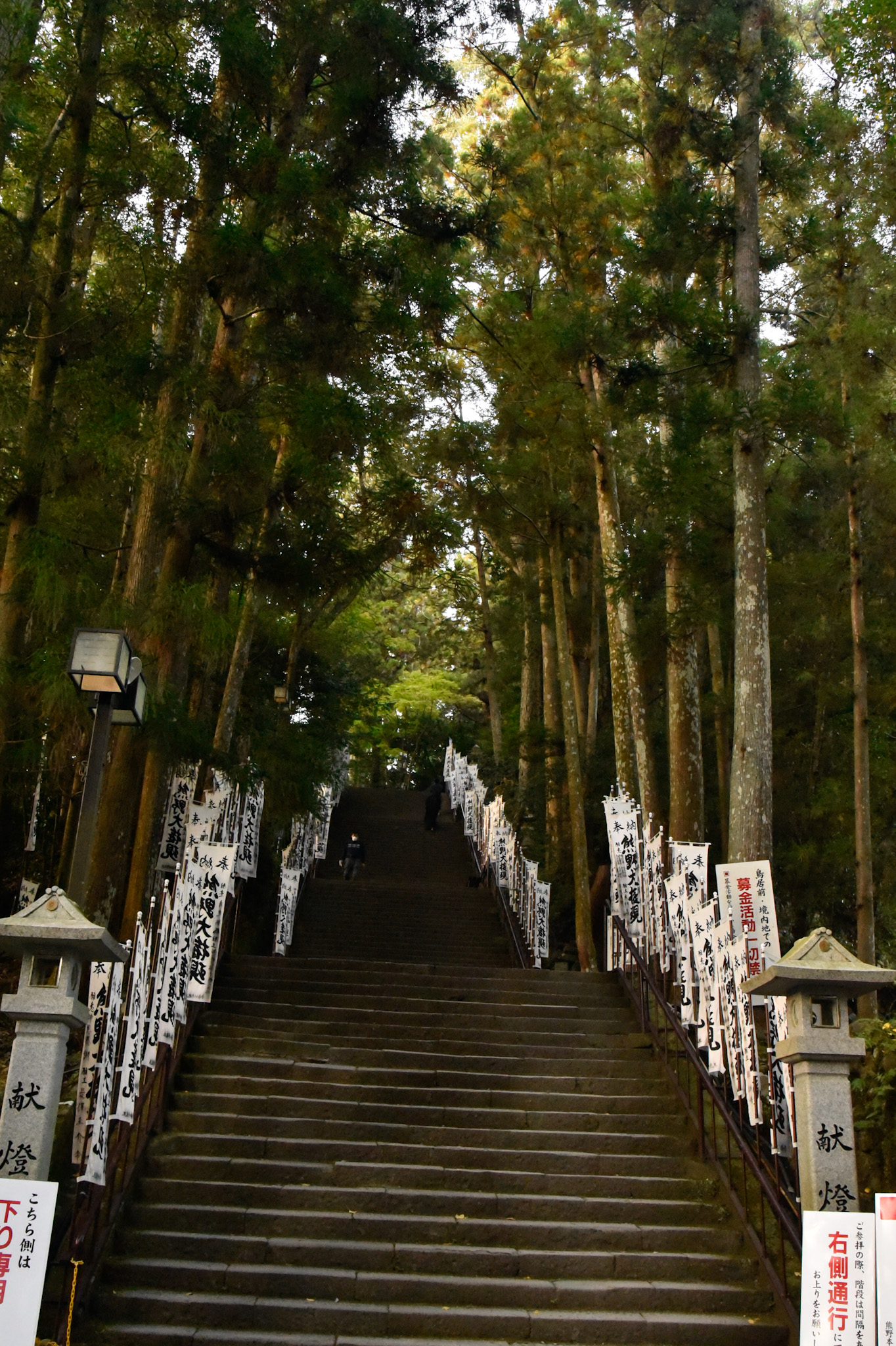
Steps lead up to the grand shrine of Kumano Hongwanji.
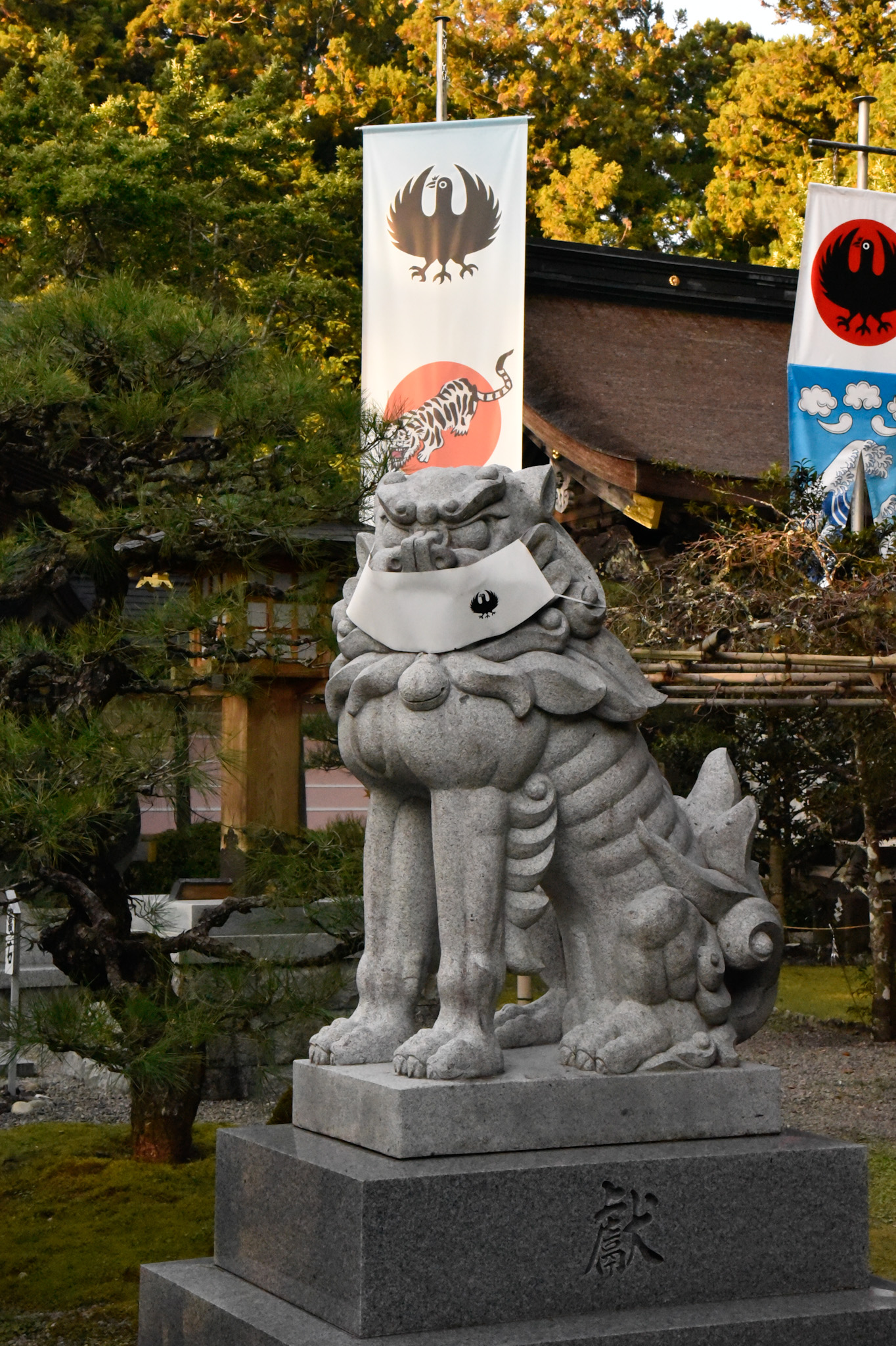
We are greeted by a mask wearing tiger at the entrance. Mask wearing is assiduously followed throughout Japan and the Covid rate is low. We were in the first wave of tourists allowed into Japan without being tested and without having to go through an arduous on line process documenting our every move.

Natural and rustic, the unfinished wood pavilions blend in with the surrounding forest. The graceful, sweeping roof is made of Japanese cypress bark and the bronze ornaments bring a blaze of reflected sunlight. It is perfect!

The secluded small village of Yunomine Olsen is the world’s only Hot Spring UNESCO World Heritage Site. People bring their eggs to cook in the boiling water.
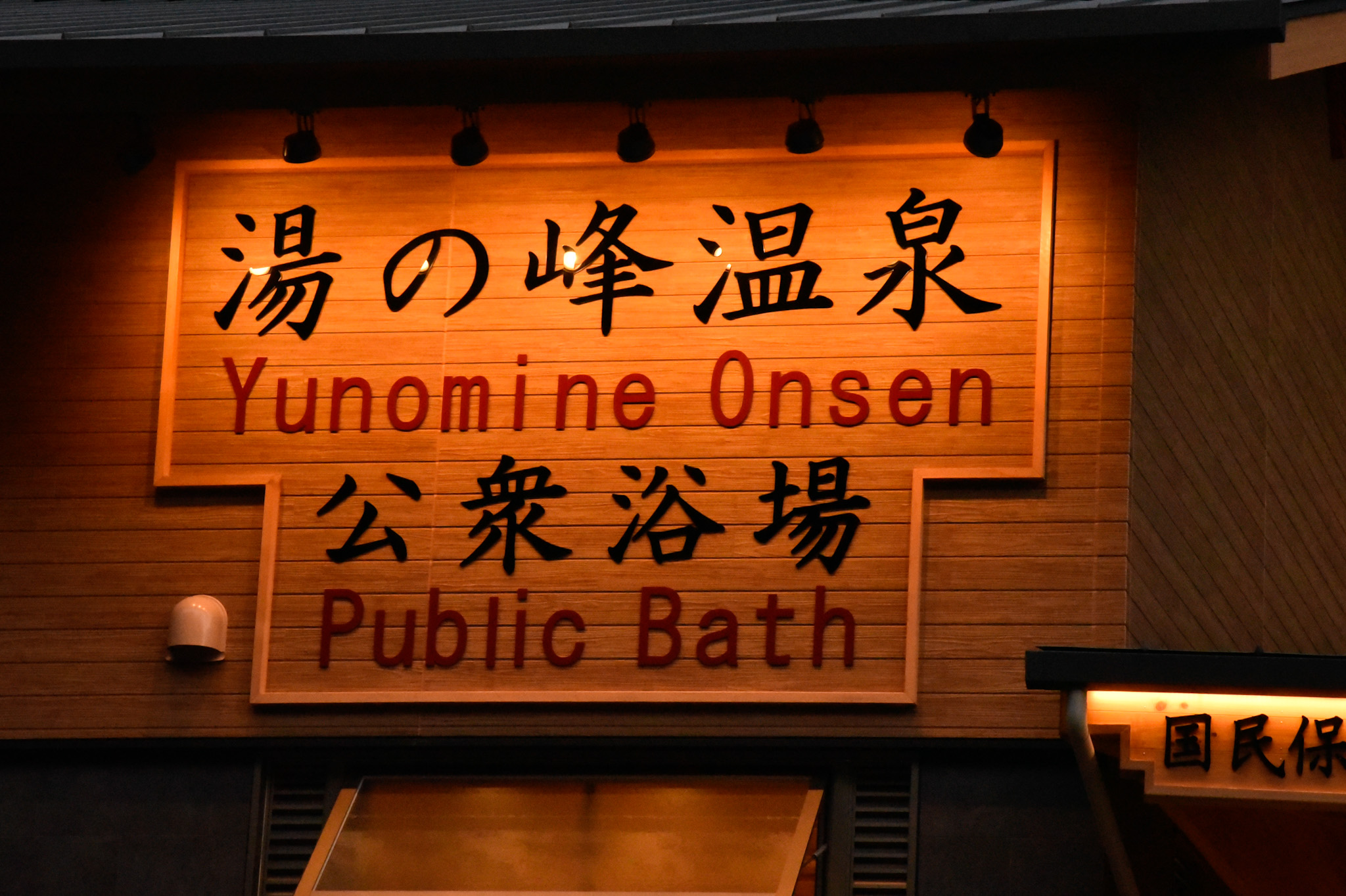
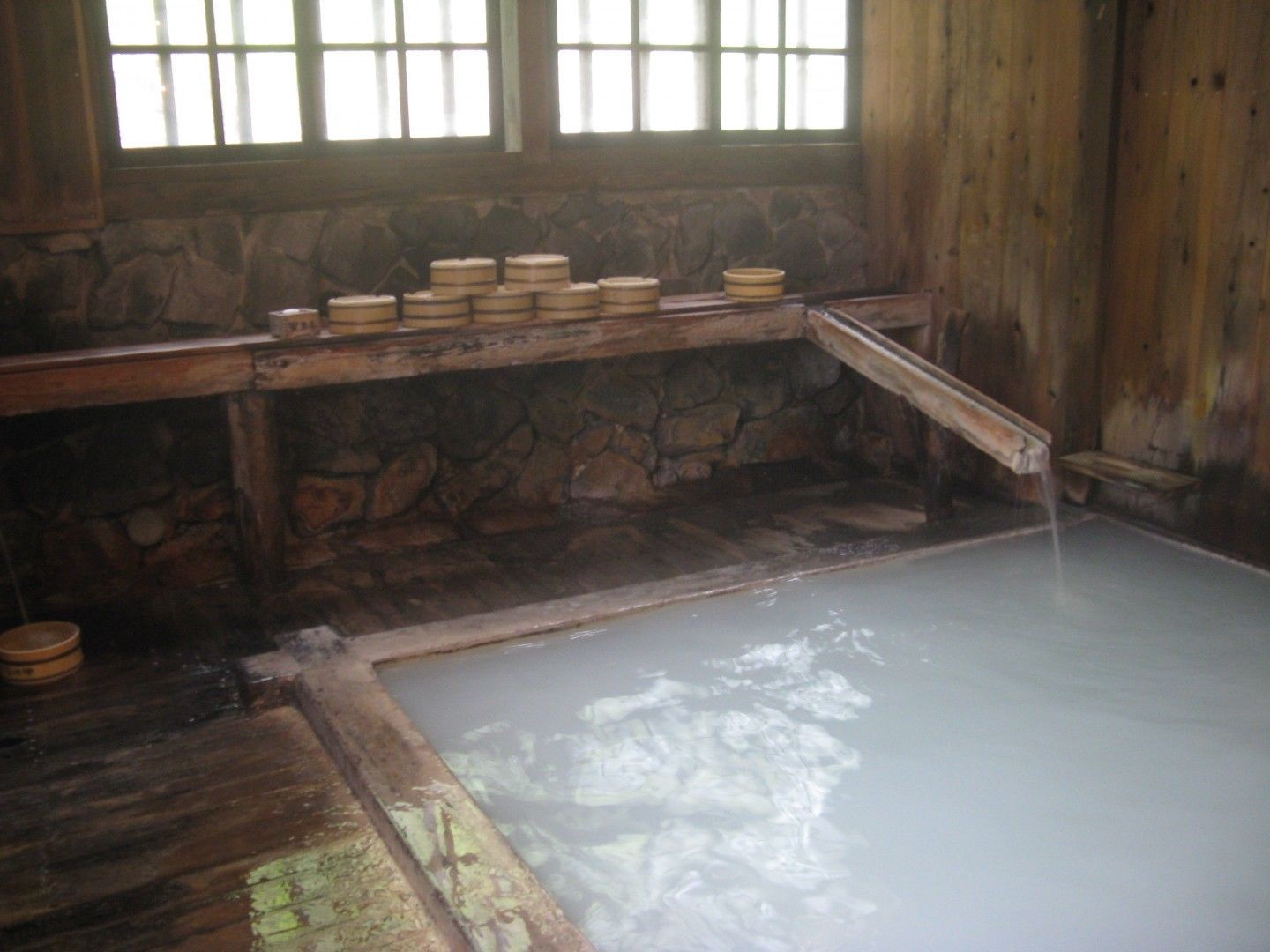
There is a public bath. A few ryokans have their own indoor and outdoor onsens. The onsen is one of the great delights when traveling in Japan. Basically, you get naked, shower off well and slip into very hot mineral water. Other people may already be there (can be gender separated or not) including extended families with children and grandparents. It is so outside our US experience for generations to bathe naked together. The setting can be simple or elaborate. No matter, it is a wonderful way to share. After soaking as long as you want, you dry off, put on your yukata, and return to your room to then go to dinner or you just fall into the best sleep. Below is a photo taken off the internet. It is included just to give an idea of what a simple onsen can be like.
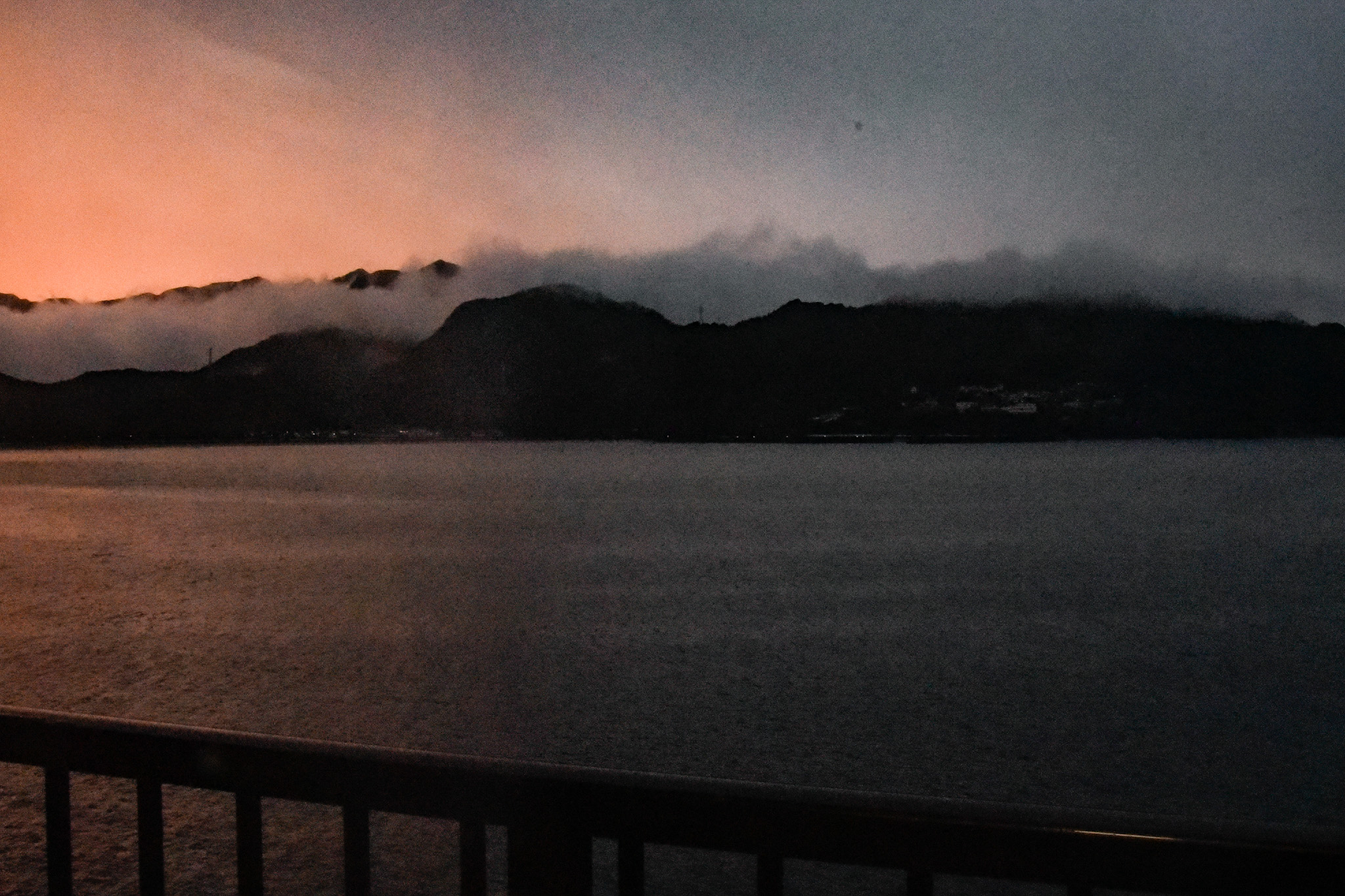
The next morning brought rain for a ride up the Kumano River in a traditional wooden flat-bottomed boat. For those of us who relied on water repellant rather than water PROOF outerwear it was an incredibly wet experience. It was also quite beautiful and when the boat stopped and one of the river guides took out a flute and played, it was otherworldly.
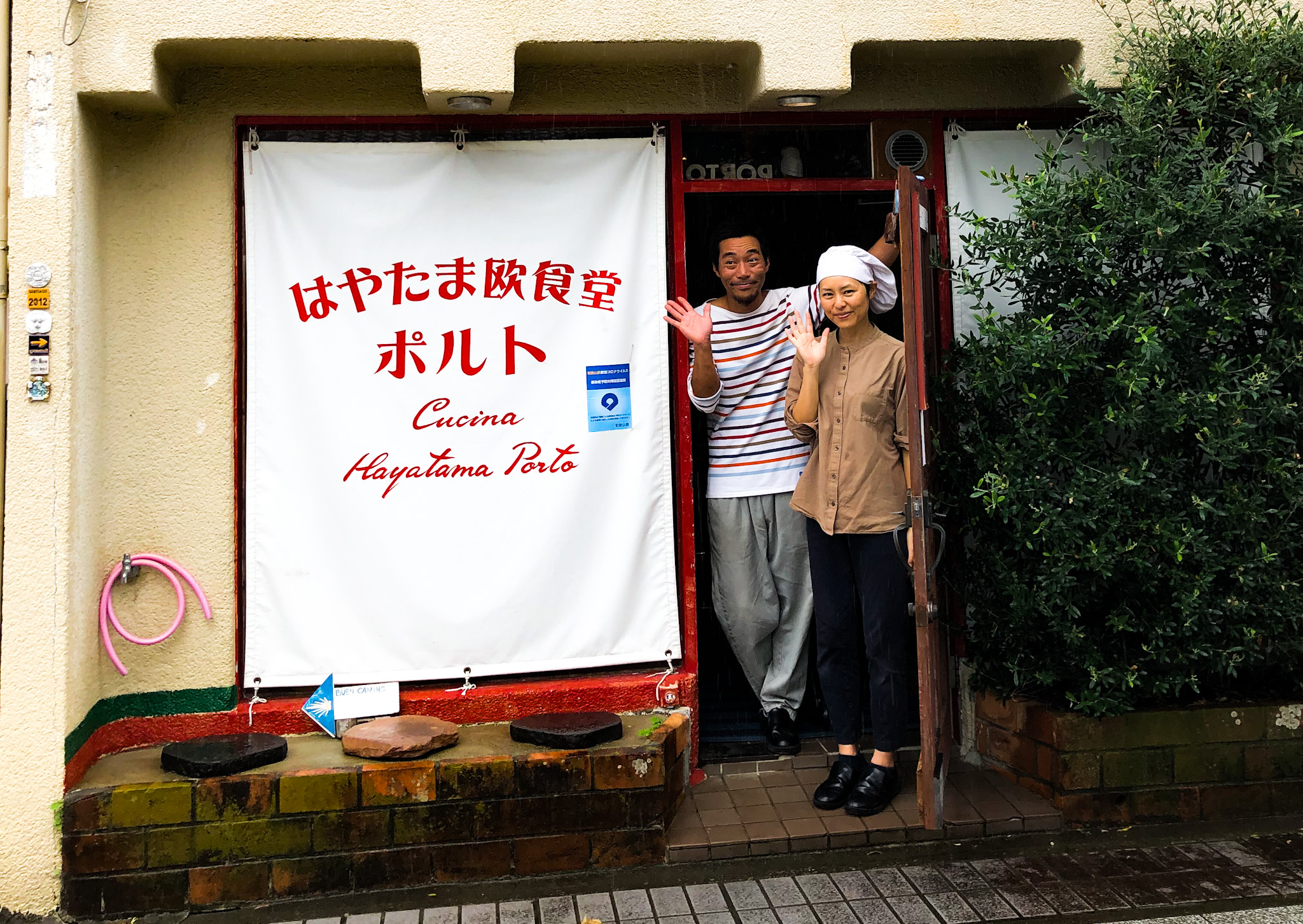
Lunch and a dry place came not a moment too soon at this charming Italian restaurant run by a young Japanese couple who had spent time in Italy. It featured puréed Japanese kabocha squash and sautéed chicken over home made pasta. Quite delicious.
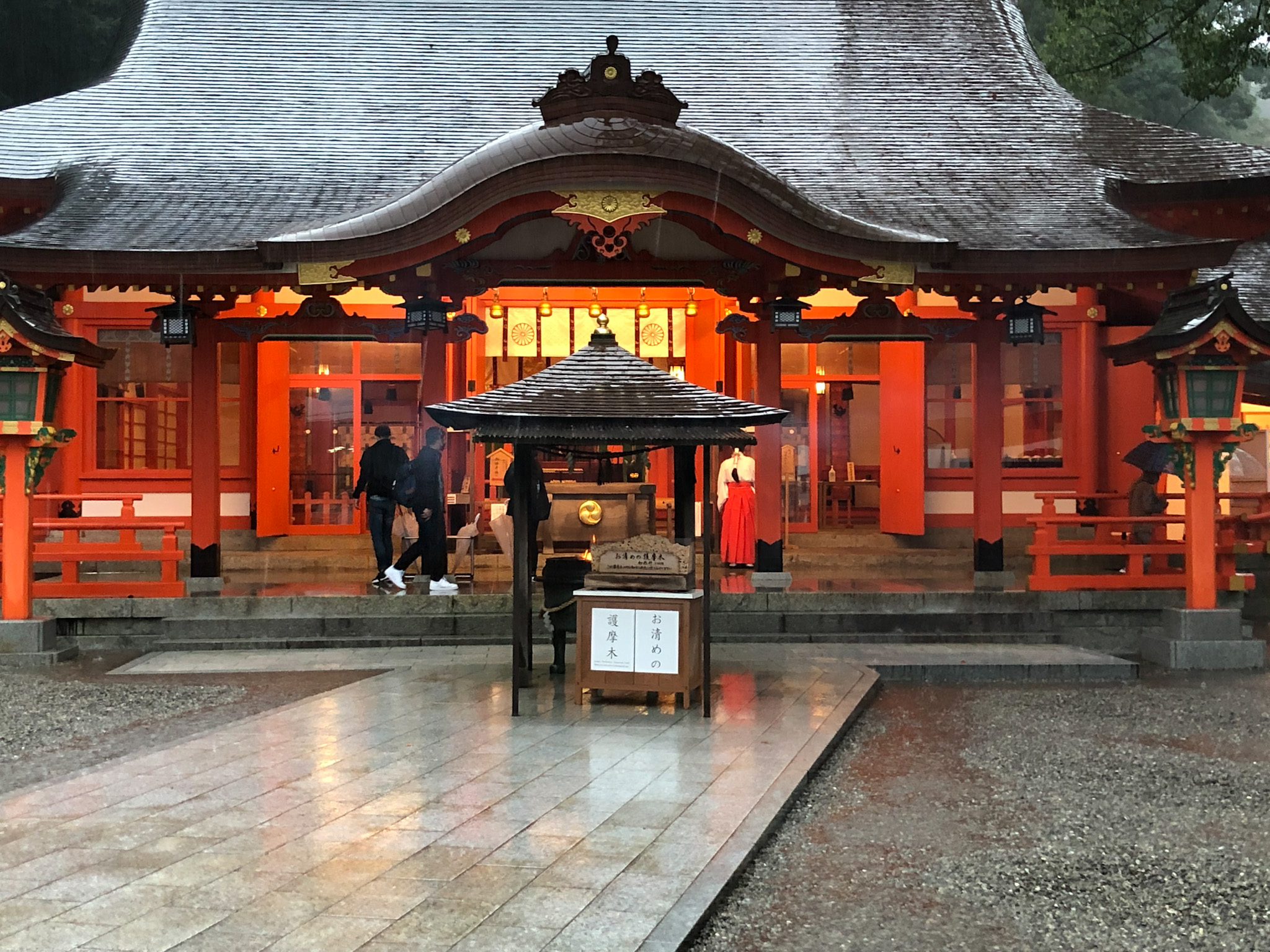
The rain kept falling hard when we visited the Nachi Taisha Grand Shrine where we read our fortunes, made our wishes, and ducked from overhang to overhang to stay dry.
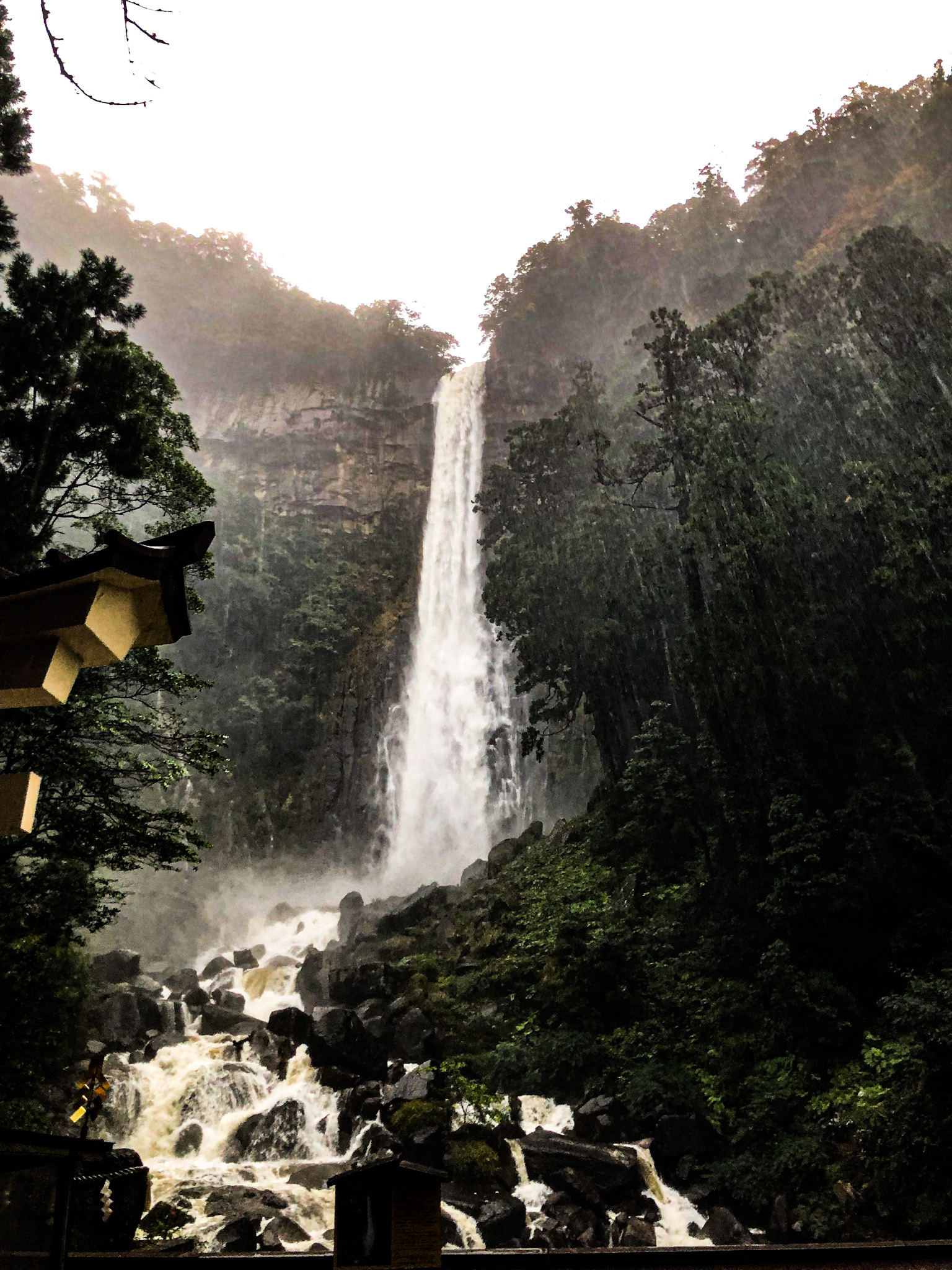
Everyone (except Jojo) trudged up the steep steps to see the dramatic Nachi-Taki Falls.
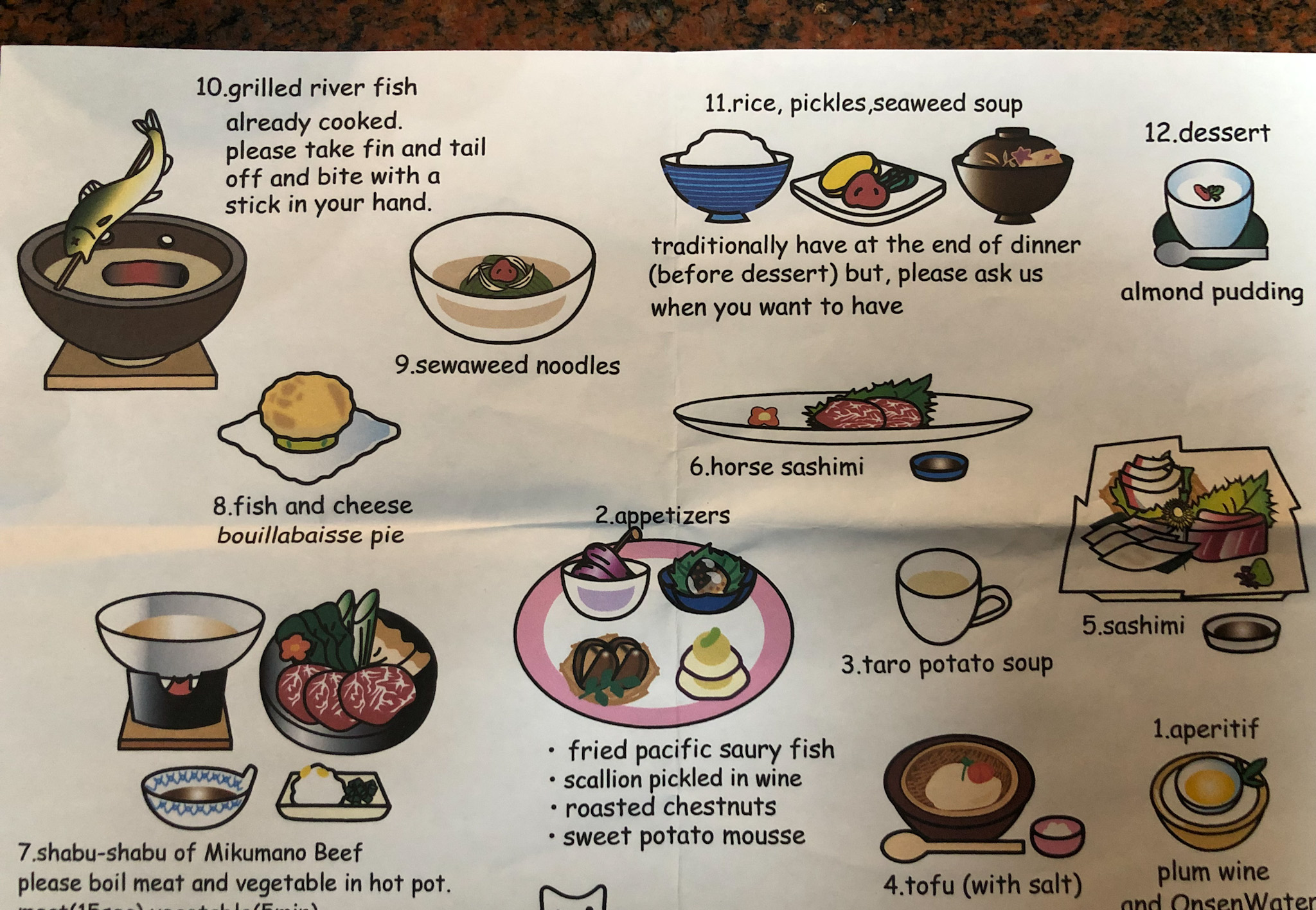
That night we stayed in Kii-Katsura and had an elaborate 10 course dinner. Below is the menu, which featured such delicacies as grilled river fish, Shabu Shabu and horse sashimi.
That evening, we learned that dear, sweet Yuki, our hard working assistant guide, had tested positive for COVID. We learned that she had been taken to a hotel that serves as a quarantine facility. We were shocked and felt terrible.
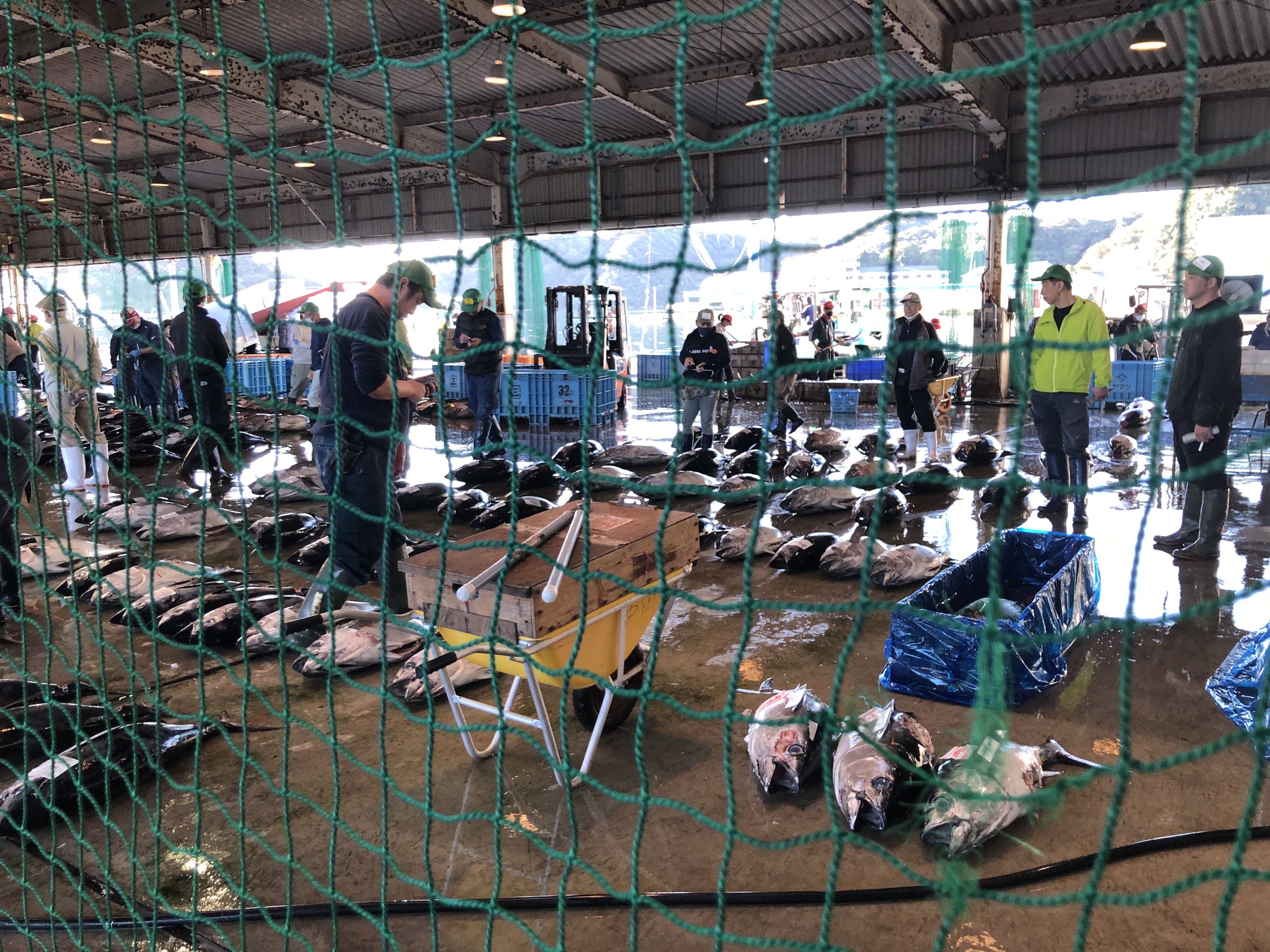
The next morning, following a western breakfast, we visited the Kii-Katsura Port, which is the largest tuna market in Japan and took a train to begin our hike of the Nakasendo.
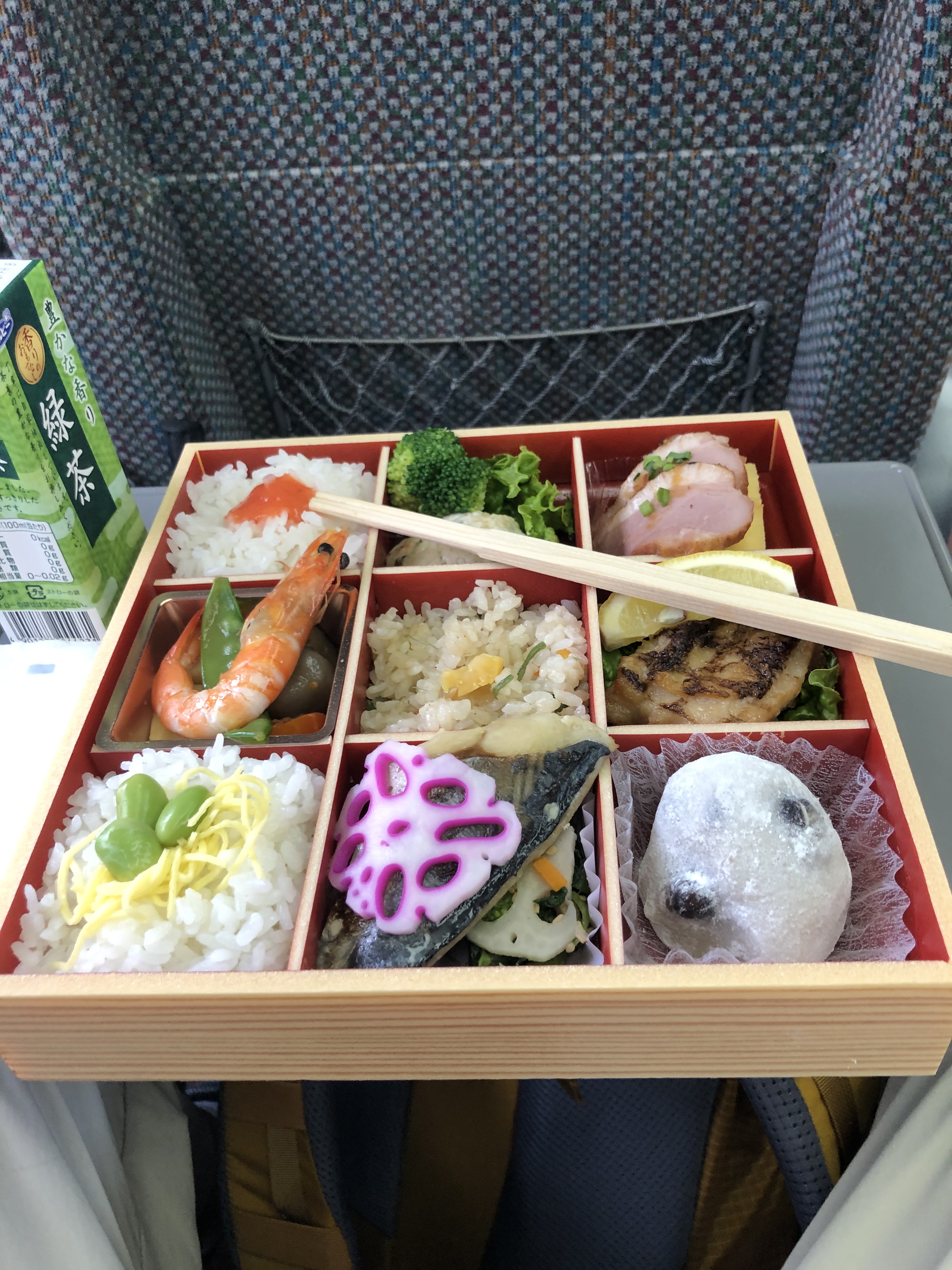
This is the bento box that contained our lunch to be eaten on the train. The bento box is an ingenious method of presenting food beautifully in a sustainable way. 1. The food is so delicious so there is little waste and 2. The sectioned wooden box it comes in is reusable. The history of the bento box which is a unique feature of Japanese cuisine, can be traced to the Kamakura period in the 1300’s.
That afternoon we start the Nakasendo Trail.
 westwardhowithapollo
Hi Joanne and Mitch,
The photos and texts really convey an exotic experience that you truly enjoyed. We look forward to hearing more details when we next see each other.
Best,
Michael
>
Sublime!
Sent from my iPhone
<
div dir=”ltr”>
<
blockquote type=”cite”>